
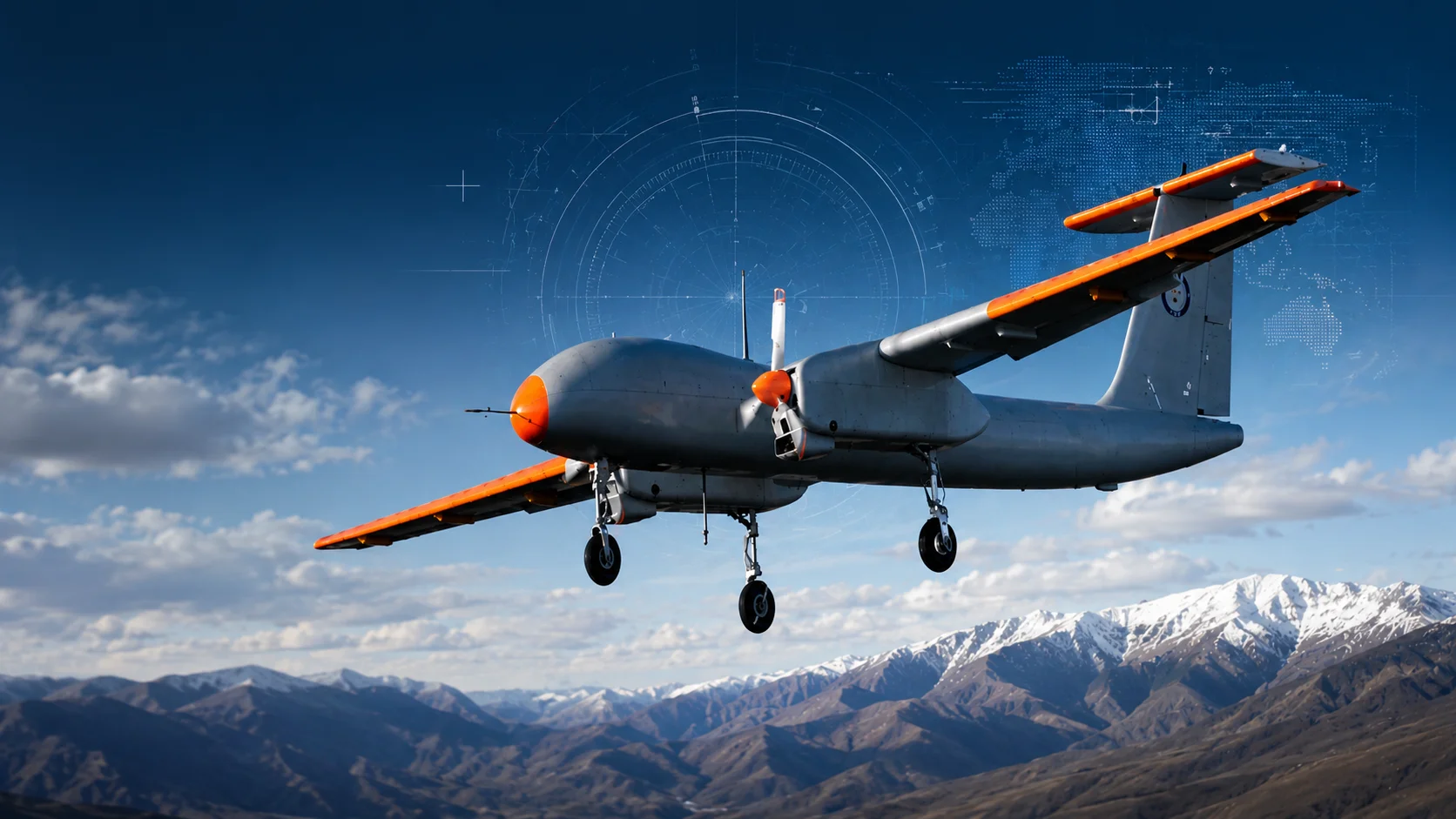
The weapon system that will define how India fights, defends, and exports for the next decade and why its biggest vulnerability is also its largest investment opportunity.
The character of modern warfare has shifted from mass manpower to autonomous, unmanned systems and nowhere is the threat environment more complex than on the Indian subcontinent, where 3,488 km of border with China, 3,323 km with Pakistan, a 7,516 km coastline, and active insurgencies converge. Operation Sindoor in May 2025 was the sector’s inflection point: for the first time in the history of the India–Pakistan conflict, drones were not supporting assets but the main instrument of engagement. The operation proved the doctrine and exposed the gaps: near-total dependence on Chinese components, the absence of an indigenous platform, and an ecosystem that assembles drones rather than builds them.
Beneath the policy response lies uncomfortable arithmetic. Drones have inverted the cost economics of aerial warfare : interceptors and surface-to-air missiles run ₹2 crore to ₹43 crore each, while the loitering munitions are meant to stop cost roughly ₹5 lakh and are fielded in volume. At the scale India’s threat environment demands the Army alone envisions 8,000–10,000 UAVs per corps only a scaled indigenous manufacturing base makes strategic and fiscal sense. The market reflects this: India’s drone sector is projected to grow at a 24.4% CAGR, from $470 million in 2025 to $1.39 billion by 2030, underpinned by government-mandated demand.
The standard objection is that India’s OEMs remain “glorified assembly lines,” importing 45–60% of critical components by value, with that dependency concentrated in China and in the high-end subsystems that define a drone’s lethality. We believe this inverts the implication. The pain is precisely what creates the policy moat: every barred Chinese component is a forced demand event. The technical problems are real and capital-intensive, requiring five-to-seven-year commitments, but they are solvable, and the companies that have committed to supply-chain depth rather than imported-component revenue have been the natural beneficiaries of policy capture.
The China risk, moreover, is asymmetric and underpriced. The supply-chain strain that reads today as the largest vulnerability is, on closer inspection, the precondition for its largest opportunity domestically through policy, globally through decoupling.
Mapping the supply-chain stack, policy, and procurement cycles, we identify six themes where demand is contractually visible and the competitive landscape remains open to venture- and growth-stage entry.
These are not future opportunities. They are present-tense investment windows, opening in 12-to-24-month increments, into a sector that will define how India fights, defends, and exports for the next decade. The full report maps India’s drone arsenal across altitude, payload, and endurance; assesses the supply-chain and certification bottlenecks in depth; and lays out Argan’s conviction across all six themes.
If you’re building in this space, raising capital, or want to exchange notes on where the sector is heading, reach out at
usingh@argan.global.